Understanding Command Words and Problem Types
Introduction
Understanding Command Words and Problem Types
This lesson explores the command words used in assessments and introduces the fundamental concepts of problem solving, including how to interpret, own, and engage with problems effectively.
Command Words
The table below includes command words used in the assessment for this syllabus. The use of the command word will relate to the subject context.
| Command word | What it means |
|---|---|
| Analyse* | Examine in detail to show meaning, identify elements and the relationship between them |
| Assess | Make an informed judgement |
| Calculate | Work out from given facts, figures or information |
| Compare | Identify/comment on similarities and/or differences |
| Evaluate | Judge or calculate the quality, importance, amount or value of something |
| Explain | Set out purposes or reasons/make the relationships between things evident/provide why and/or how and support with relevant evidence |
| Give | Produce an answer from a given source or recall/memory |
| Identify* | Name/select/recognise |
| Justify | Support a case with evidence/argument |
| Predict | Suggest what may happen based on available information |
| State | Express in clear terms |
| Suggest* | Apply knowledge and understanding to situations where there is a range of valid responses in order to make proposals |
* In Paper 2 and Paper 4, 'analyse' requires you to identify key elements of an argument. 'Identify' means you should find something from within the source itself, whereas 'suggest' means you should come up with an idea of your own.
Angus Grogono and Colin Hart
Interpreting the Problem
By the end of this chapter you will be able to:
- take ownership of a problem
- model a problem
- pose a problem
- engage with an exam question.
You may think that problems are like traps. They check whether you, the problem-solving pioneer, are sufficiently skilled and self-aware to locate the 'right answer' amidst the tempting wrong ones. They can appear to be deliberately obscure, designed to confuse the reader by their means of presentation. And, on top of it all, what are they good for, apart from making bright-eyed innocent teenagers, like you, feel stupid?
Real-life problems:
- rarely have one answer
- normally allow some scope for interaction (to check that the details mean what they appear to mean)
- often involve a situation with which you have some familiarity (problems often arise from a context which you have partly created yourself).
Success in posing problems and finding efficient answers will inevitably lead to your success in life. (If you doubt this, then pose yourself the problem: 'How can I achieve success in life?' And then find an efficient solution to it!)
This first chapter will show you how the world of real-life problem solving and the world of the problem-solving exam paper are linked. This is because, in order to successfully solve problems in both situations, you need to:
- have a feeling for the context of the problem
- have confidence to interact with and probe the problem
- be familiar with the difficulties of modelling and articulating the problem.
This will enable you to extract the information from a problem confidently, carefully and efficiently.
You may be tempted to omit some of the sections, since they seem too distant from the reality of problem solving. But beware: you don't become a performance musician by studying what a performance musician looks like. You need to cultivate the underlying disciplines and attitudes as well as the surface-level skills. The foundational work on how a problem is created and presented will ensure you are genuinely prepared for new problems, both in your everyday life and when tackling an exam paper.
Owning the Problem
Every problem-solving course should begin with the creation of problems so, first, let us look at what we mean by 'a problem'.
At its heart, every problem is a question that needs to be answered, so we must begin by considering anything (and everything) about which you could pose a question.
ACTIVITY
Here are 14 questions relating to food as they might occur to a day-dreaming, inquisitive human like you.
What different types of questions are there? Read through them all, and then choose a way of sorting them into groups. (Make sure that every question is included in a group.)
There is not meant to be one correct way of grouping the questions. Once you have chosen your own method of grouping, discuss it with your classmates. Did they choose to group their questions differently? How? Why?
- How much food can I fit in my stomach?
- How long has anyone ever lasted without food?
- Is a perfect pineapple more delicious than a perfect plum?
- Don't you just love eating raw carrots?
- Does the number of times food is chewed affect the amount of energy extracted from it?
- How much of this cake should I give to my sister?
- What is the shortest route that allows me to buy bread (B), cheese (C) and jam (J) in a supermarket with this floorplan?
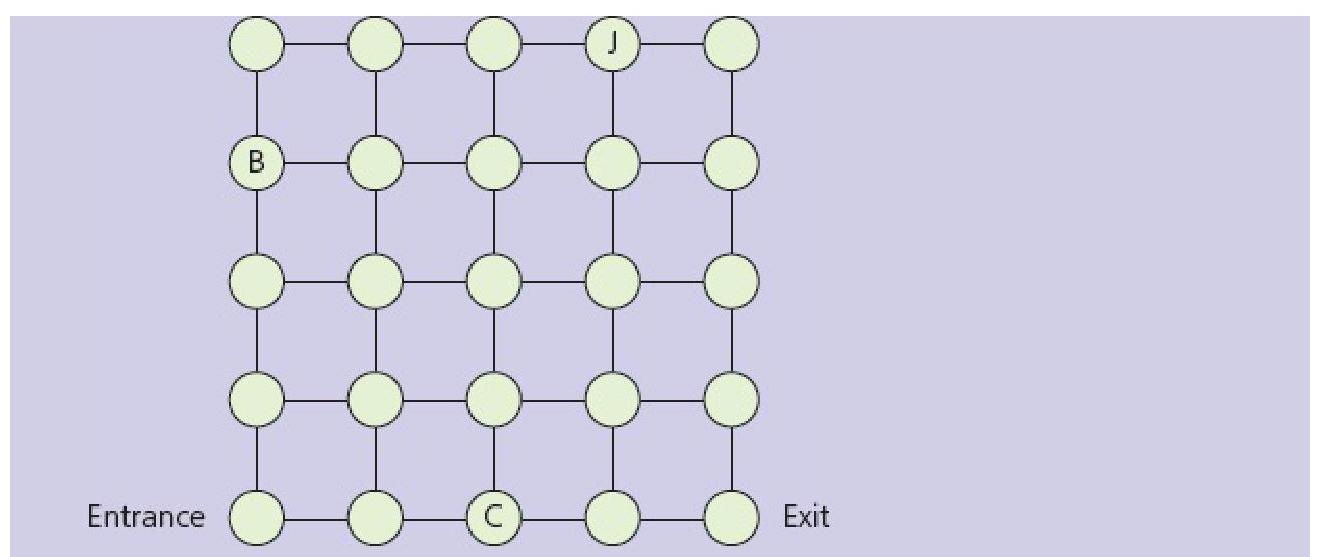
8 Can I get to the shop before it closes?
9 What is the best way to cook this food?
10 Can a meal be a work of art?
11 Is paper edible?
12 If the chutney I have bought lists the following ingredients – onions, peppers, sugar (10%), oil, vinegar and spices – and I know that they are in quantity order (with onions being the largest ingredient), what percentage of the chutney could be oil?
13 Should I eat animals?
14 What carnivores do humans eat?
How have you grouped the questions?
You may have divided them by:
- whether they are subjective questions (involving the tastes and values of the questioner) or objective (independent of the tastes and values of the questioner); for example, Questions 3 and 9 are typically subjective, and Questions 5 and 7 are typically objective.
- whether they are closed questions (which can be answered with a brief factual answer, sometimes just yes/no) or open (which invite discussion, justification, analysis); for example, Questions 1 and 9 are typically closed questions, and Questions 10 and 13 are typically open.
- whether they are personal, indexical questions (where the answer differs depending on who asks the question, and when they ask it), or whether the answer is independent of who asks; for example, Questions 1 and 8 are typically indexical, and Questions 2 and 7 are not.
- whether they are normative (about what should be the case) or descriptive (about what is the case); for example, Questions 6 and 13 are typically normative, and Questions 12 and 14 are typically descriptive.
- whether they can be answered by GoogleTM, or not: this will change over time, but GoogleTM offered answers to Questions 11 and 13 at the time of writing, but not Questions 4 or 8.
Key term
Indexical (adjective) – Where the meaning or truth of a statement depends on who says it.
The questions relevant to this course will be ones which are:
- seeking an answer, rather than just being 'rhetorical'. Question 4 is an example of a rhetorical question, in which the primary aim of the question is to state that carrots are wonderful things, rather than to find out anything.
- descriptive rather than normative. These are not essentially about what we value, but about what is true. Some questions have normative elements which are not the main focus of the question, for example, 'How should I divide this irregularly shaped piece of cheese between me and my sister?' where it is necessary to clarify the evaluative element before progressing. Once it is determined what value structure we are conforming to (for example, equal distribution might be the primary value structure), the problem becomes descriptive: 'How can I divide the object up into equal sections?' (by trial and error, and using a pair of balancing scales, for example).
- not just a fact-checking exercise. For example, Question 2 essentially requires a list of how long anyone has ever lasted without food – once we have found and sorted this information, the answer is self-evident. Such questions may be challenging to answer because the information is hard to find, but the difficulty of the task lies in the effort in locating and accessing the right source of information, rather than in analysing the (available) parts to achieve the goal.
In reality, most problems require a combination of two processes – information search and analysis. Problem solving, as an independent skill, focuses on analysing how different parts of a problem can be combined to achieve a particular goal (where the relevant information is given).
In the list of questions from the activity, the following questions would immediately qualify for this course:
- 7 and 12 – the relevant information is given. The question can be answered by analysing the options.
The questions below would be good vehicles for problem solving if sufficient additional information was given:
- 1 – possibly, given information about the dietary habits of the person asking the question
- 6 – if some criterion for dividing up cake were given
- 8 – (given information about where the shop is, how fast the question poser can move, when the shop closes.
While these questions would be a test of information finding rather than analysis:
- 2 – as suggested, this requires a historical look at who ate what, when, and who survived
- 5 – a classic vehicle for scientific enquiry
- 14 – like 2, this essentially requires a list of people's eating habits.
The remaining questions require either an examination of tastes, values and meaning, or are not primarily seeking an answer:
- 3 (taste); 4 (rhetorical); 6 (values); 9 (taste); 10 (values); 11 (meaning); 13 (values).
Sign up to track progress
Create a free account to mark lessons complete, track your learning progress, and access study tools