Introduction to Exponential and Logarithmic Functions
Introduction
Introduction to Exponential and Logarithmic Functions
This chapter explores exponential functions and logarithmic functions, their properties, graphs, and real-world applications. You will learn how to work with exponents and logarithms, solve equations involving these functions, and apply these skills to practical situations.
Chapter Objectives:
1.2 Elementary treatment of exponents and logarithms
Laws of exponents; laws of logarithms; change of base
2.6 Exponential functions and their graphs
$ x \mapsto a^{x}, a>0, x \mapsto \mathrm{e}^{x} $
Logarithmic functions and their graphs
$ x \mapsto \log_{a} x, x>0, x \mapsto \ln x, x>0 $
Relationship between these functions
$ a^{x}=\mathrm{e}^{x \ln a}, \log_{a} a^{x}=x; a^{\log_{a} x}=x, x>0 $
2.7 Solving equations of the form $ a^{x}=b, a^{x}=b^{y} $
2.8 Applications of graphing skills and solving equations to real-life situations
Before You Start
You should know how to:
1 Evaluate simple positive exponents
e.g. Evaluate $ 3^{4} $
$ 3^{4}=3 \times 3 \times 3 \times 3=81 $
e.g. Evaluate $ \left(\frac{2}{5}\right)^{3} $
$ \left(\frac{2}{5}\right)^{3}=\frac{2^{3}}{5^{3}}=\frac{2 \times 2 \times 2}{5 \times 5 \times 5}=\frac{8}{125} $
2 Convert numbers to exponential form
e.g. Find $ n $ given $ 2^{n}=128 $
$ 128=2^{7} $ so $ n=7 $
3 Transform graphs
e.g. Given the graph of $ y=x^{2} $ sketch the graph of $ y=x^{2}+3 $
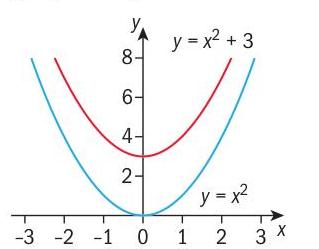
Skills Check
1 Evaluate
a $ \left(\frac{3}{4}\right)^{4} $
b $ \left(\frac{1}{2}\right)^{7} $
c $ 0.001^{3} $
2 State the value of $ n $ in these equations.
a $ 7^{n}=343 $
b $ 3^{n}=243 $
c $ 5^{n}=625 $
3 Transform the graph of $ y=x^{2} $ to give the graph of $ y=(x-2)^{2} $

Real-World Applications
Facebook, the social media giant, celebrated its sixth birthday in February 2010 with more than 450 million users, up from about 100 million in August 2008 and a huge increase from December 2004 when there were one million members.
This graph shows how the number of Facebook users has increased over time.
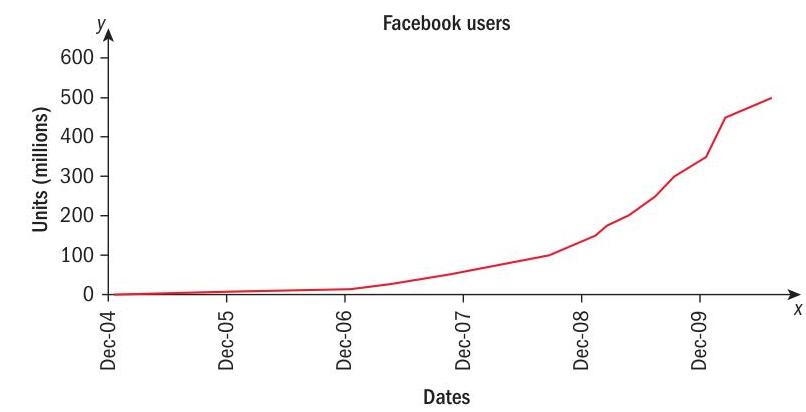
(Source: http://www.facebook.com/press/info.php?timeline)
Growth like this (certainly until February 2010) is exponential growth. As you move along the curve its gradient increases with the growth rate. The growth rate at any time is roughly proportional to the number of users at that time.
A good model for the data on Facebook users is $ n=1.32 \times 1.1^{x} $ where $ n $ is the number of users in millions, and $ x $ is the number of months after December 2004.
You could use the equation $ n=1.32 \times 1.1^{x} $ to estimate the number of users at any specified date or to find the date at which a particular number of users was reached.
You will come across many other examples of exponential growth and its opposite, exponential decay (where the gradient decreases as you move along the curve).
You could also use the model to make predictions about the future growth of Facebook. This is called 'extrapolation'. What are the problems with using a model of this type to estimate future growth? What other factors do you need to consider?
Investigation - Paper Folding
Investigation - folding paper
Malcolm Gladwell posed this problem in his book The Tipping Point. Imagine taking a large piece of paper, and folding it over again and again, until you have folded it 50 times. How high do you think the final stack would be?
1 Fold a sheet of paper (any size) in half as many times as possible.
2 For each fold, complete this table to show the number of folds, the number of layers and the thickness of the paper formed. You can assume that a sheet of paper is about 0.1 mm thick, that is $ 1 \times 10^{-7} $ km.
The first few entries have been done
| Number of folds |
Number of layers |
Thickness (km) | As thick as a |
|---|---|---|---|
| 0 | 1 | $ 1 \times 10^{-7} $ | Piece of paper |
| 1 | 2 | $ 2 \times 10^{-7} $ | |
| 2 | 4 | $ 4 \times 10^{-7} $ | Credit card |
| 3 | 8 | ||
| 4 | 16 | ||
| 5 | |||
| 6 | |||
| 7 | |||
| 8 | |||
| 9 |
3 How many folds would you need to make the paper
a as thick as the height of a table?
b just taller than the height of a man?
4 How thick would the paper be after 50 folds?
You can probably get to about six or seven folds before you can't fold the paper any more. At seven folds the paper is already about as thick as this textbook. In fact after only 13 folds the paper is roughly the height of a table and after 15 folds it will be much taller than any man. After 17 folds it is roughly 13 m thick, roughly the height of a two-storey house!
After 50 folds the paper would be approximately 113 million km thick. This is about the distance from the Earth to the Sun.
Paper folding is an example of exponential growth. The 'number of layers' of paper form a sequence. The terms in the sequence are a function of the number of folds, $ n $, where $ f(n) = 2^n $.
$ f(n) $ is an exponential growth function.
In this chapter you will learn more about exponential functions and their inverses, which are called logarithmic functions.
Exponents
4.1 Exponents
Exponents are a shorthand way of representing the repeated multiplication of a number by itself.
The expression $ 3^5 $, for example, represents $ 3 \times 3 \times 3 \times 3 \times 3 $. The 3 in this expression is the base number and the 5 is the exponent.
Other names for exponent are power and index.
You can also use a variable as the base, for example, $ x^4 = x \times x \times x \times x $
Laws of exponents
Multiplication
Simplify $ x^5 \times x^3 $
$ x^5 \times x^3 = (x \times x \times x \times x \times x) \times (x \times x \times x) $
$ = x \times x \times x \times x \times x \times x \times x \times x $
$ = x^8 $
So $ x^5 \times x^3 = x^{(5+3)} = x^8 $
$ \rightarrow a^m \times a^n = a^{m+n} $
Sign up to track progress
Create a free account to mark lessons complete, track your learning progress, and access study tools