Moles, Atoms, Symbols, and Compound Formulae
The Mole
Moles, Atoms, Symbols, and Compound Formulae
Chemists deal with real, measured quantities of substances. Rather than counting atoms individually, we prefer to count them in units that are easily measable. The gram is a conveniently sized unit of mass to use for weighing out matter (a teaspoon of sugar, for example, weighs about 5 g).
The chemist's unit of amount, the mole (symbol mol), is defined in terms of grams:
One mole of an element is the amount that contains the same number of atoms as there are in 12.000 g of carbon-12.
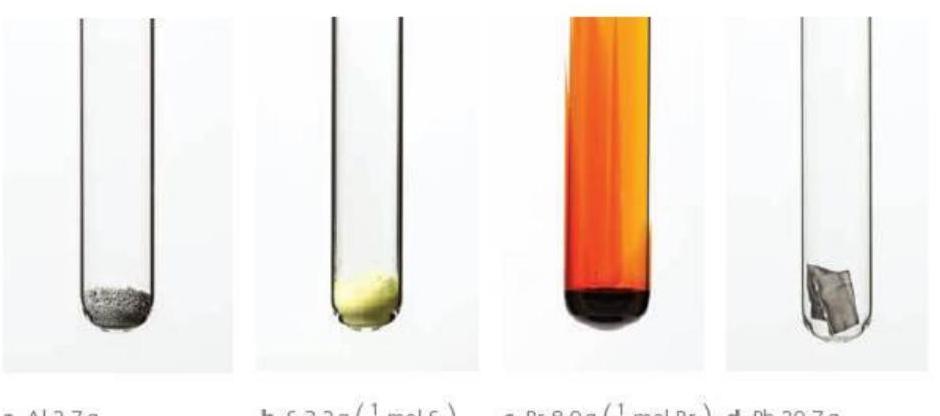
Figure 1.5 One-tenth of a mole of each of the elements aluminium, sulfur, bromine and lead
The mass of one mole of an element is called its molar mass (symbol $M$). It is numerically equal to its relative atomic mass, $A_r$, but is given in grams per mole:
- relative atomic mass of carbon $= 12.0$
- molar mass of carbon $= 12.0 \mathrm{~g~mol}^{-1}$
- relative atomic mass of magnesium $= 24.0$
- molar mass of magnesium $= 24.0 \mathrm{~g~mol}^{-1}$
It follows from the above definition that there is a clear relationship between the mass ($m$) of a sample of an element and the number of moles ($n$) it contains:
$\text{amount (in moles)} = \frac{\text{mass}}{\text{molar mass}}$
$\text{or} \quad n = \frac{m}{M} \text{ mol}$ (1)
Now try this
Using the $A_r$ values O = 16.0, Mg = 24.0, S = 32.0, calculate the amount of substance (in moles) in each of the following samples.
- 1 24.0 g of oxygen
- 2 24.0 g of sulfur
- 3 16.0 g of magnesium
Worked example
What is the amount (in moles) of carbon in 30 g of carbon?
Answer
Use the value $A_r(\text{carbon}) = 12.0$ to write its molar mass, and use equation (1) above:
- $m = 30 \text{ g}$ and $M = 12.0 \text{ g mol}^{-1}$
- so $n = \frac{30 \text{ g}}{12.0 \text{ g mol}^{-1}}$
= 2.5 mol
The Avogadro Constant
As we saw on page 5, the actual masses of atoms are very small. We would therefore expect the number of atoms in a mole of an element to be very large. This is indeed the case.
One mole of an element contains a staggering $6.022 \times 10^{23}$ atoms (six hundred and two thousand two hundred million million million atoms). This value is called the Avogadro constant, symbol $L$.
$L = 6.022 \times 10^{23} \text{ mol}^{-1}$
The approximate value of $L = 6.0 \times 10^{23} \text{ mol}^{-1}$ is often adequate, and will be used in calculations in this book.
The relationship between the number of moles in a sample of an element and the number of atoms it contains is as follows:
$\text{number of atoms} = L \times \text{number of moles}$
$\text{or} \quad N = Ln$ (2)
Now try this
Calculate the amount of substance (in moles) in
- 1 a sample of uranium that contains $1.0 \times 10^{25}$ atoms
- 2 a sample of fluorine that contains $5 \times 10^{21}$ atoms
Worked example
How many hydrogen atoms are there in 1.5 mol of hydrogen atoms?
Answer
Use equation (2), and the value of $L$ given above:
- $L = 6.0 \times 10^{23} \text{ mol}^{-1}$ and $n = 1.5 \text{ mol}$
- so $N = 6.0 \times 10^{23} \text{ mol}^{-1} \times 1.5 \text{ mol}$
= 9.0 × 10²³
Atomic Symbols and Formulae
Each element has a unique symbol. Symbols consist of either one or two letters. The first is always a capital letter and the second, if present, is always a lower-case letter. This rule avoids confusions and ambiguities when the symbols are combined to make the formulae of compounds.
For example:
- the symbol for hydrogen is H
- the symbol for helium is He (not HE or hE)
- the symbol for cobalt is Co (not CO – this is the formula of carbon monoxide, which contains two atoms in its molecule, one of carbon and one of oxygen).
Symbols are combined to make up the formulae of compounds. If more than one atom of a particular element is present, its symbol is followed by a subscript giving the number of atoms of that element contained in one formula unit of the compound.
For example:
- the formula of copper oxide is CuO (one atom of copper combined with one atom of oxygen)
- the formula of water is $\mathrm{H}_{2}\mathrm{O}$ (two atoms of hydrogen combined with one atom of oxygen)
- the formula of phosphoric(V) acid is $\mathrm{H}_{3}\mathrm{PO}_{4}$ (three atoms of hydrogen combined with one of phosphorus and four of oxygen).
Sometimes, especially when the compound consists of ions rather than molecules (see Topic 4), groups of atoms in a formula are kept together by the use of brackets. If more than one of a particular group is present, the closing bracket is followed by a subscript giving the number of groups present. This practice makes the connections between similar compounds clearer.
For example:
- the formula of sodium nitrate is $\mathrm{NaNO}_{3}$ (one sodium ion, $\mathrm{Na}^{+}$, combined with one nitrate ion, $\mathrm{NO}_{3}^{-}$, which consists of one nitrogen atom combined with three oxygen atoms)
- the formula of calcium nitrate is $\mathrm{Ca}(\mathrm{NO}_{3})_{2}$ (one calcium ion, $\mathrm{Ca}^{2+}$, combined with two nitrate ions).
Note that in calcium nitrate, the formula unit consists of one calcium, two nitrogens and six oxygens, but it is not written as $\mathrm{CaN}_{2}\mathrm{O}_{6}$. This formula would not make clear the connection between $\mathrm{Ca}(\mathrm{NO}_{3})_{2}$ and $\mathrm{NaNO}_{3}$. Both compounds are nitrates, and both undergo similar reactions of the nitrate ions.
The formulae of many ionic compounds can be predicted if the valencies of the ions are known. (The valency of an ion is the electrical charge on the ion.)
Similarly, the formulae of several of the simpler covalent (molecular) compounds can be predicted if the covalencies of the constituent atoms are known. (The covalency of an atom is the number of covalent bonds that the atom can form with adjacent atoms in a molecule.)
Lists of covalencies and ionic valencies, and examples of how to use them, are given on pages 49 and 79.
Now try this
How many atoms in total are present in one formula unit of each of the following compounds?
- 1 $\mathrm{NH}_{4}\mathrm{NO}_{3}$
- 2 $\mathrm{Na}_{2}\mathrm{Cr}_{2}\mathrm{O}_{7}$
- 3 $\mathrm{KCr}(\mathrm{SO}_{4})_{2}$
- 4 $\mathrm{C}_{6}\mathrm{H}_{12}\mathrm{O}_{6}$
- 5 $\mathrm{Na}_{3}\mathrm{Fe}(\mathrm{C}_{2}\mathrm{O}_{4})_{3}$
Worked example
How many atoms of each element are present in one formula unit of each of the following compounds?
a $\mathrm{Al}(\mathrm{OH})_{3}$
b $(\mathrm{NH}_{4})_{2}\mathrm{SO}_{4}$
Answer
a The subscript after the closing bracket multiplies all the contents of the bracket by three. There are therefore three OH (hydroxide) groups, each containing one oxygen and one hydrogen atom, making a total of:
- three oxygen atoms
- three hydrogen atoms
- one aluminium atom
b Here there are two ammonium groups, each containing one nitrogen atom and four hydrogen atoms, and one sulfate group, containing one sulfur atom and four oxygen atoms. In total, therefore, there are:
- two nitrogen atoms
- eight hydrogen atoms
- one sulfur atom
- four oxygen atoms
Sign up to track progress
Create a free account to mark lessons complete, track your learning progress, and access study tools