Molecular Sizes and Scientific Notation
Intensive and Extensive Properties
Molecular Sizes and Scientific Notation
The properties of matter may be divided into two groups:
- The extensive properties depend on how much matter we are studying. Common examples are mass and volume – a cupful of water has less mass, and less volume, than a swimming pool.
- The other group are the intensive properties, which do not depend on how much matter we have. Examples include temperature, colour and density. A copper coin and a copper jug can both have the same intensive properties, although the jug will be many times heavier (and larger) than the coin.
The chemical properties of a substance are also intensive. A small or a large lump of sodium will react in the same way with either a cupful or a jugful of water. In each case it will:
- Fizz
- Give off steam and hydrogen gas
- Produce an alkaline solution in the water
The Oil-Drop Experiment
Experiment

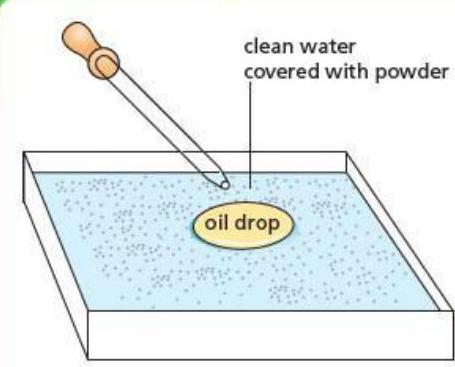
Figure 1.3 The oil-drop experiment
The oil-drop experiment
A bowl is filled with clean water and some fine powder, such as pollen grains or flour, is sprinkled over the surface. A small drop of oil is placed on the surface of the water, as shown in Figure 1.3. The oil spreads out. As it does so, it pushes the powder back, so that there is an approximately circular area clear of powder.
We can measure the volume of one drop by counting how many drops it takes to fill a micro measuring cylinder. (If we know the oil's density, an easier method would be to find the mass of, say, 20 drops.) We can calculate the area of the surface film by measuring its diameter. Assuming the volume of oil does not change when the drop spreads out, we can thus find the thickness of the film. This cannot be smaller than the length of one oil molecule (though it may be bigger, if the film is several molecules thick – there is no way of telling).
The following are typical results:
$ \text{volume of drop} = 1.0 \times 10^{-4} \text{ cm}^{3} $
$ \text{diameter of oil film} = 30 \text{ cm} $
$ \text{so radius of film} = 15 \text{ cm} $
$ \text{area of film} = \pi r^{2} $
$ = 3.14 \times 15^{2} \text{ cm}^{2} $
$ = 707 \text{ cm}^{2} $
$ \text{volume} = \text{area} \times \text{thickness} $
$ \text{so thickness} = \frac{\text{volume}}{\text{area}} $
$ = \frac{1.0 \times 10^{-4} \text{ cm}^{3}}{707 \text{ cm}^{2}} $
$ = \mathbf{1.4 \times 10^{-7}} \textbf{ cm} (1.4 \times 10^{-9} \text{ m}) $
Distances this small are usually expressed in units of nanometres:
$ 1 \text{ nanometre (nm)} = 1 \times 10^{-9} \text{ metres (m)} $
So the film is 1.4 nm thick. Oil molecules cannot be larger than this.
The Sizes of Atoms and Molecules
Just as we believe that elements are composed of identical atoms, so we also believe that compounds are made up of many identical units. These units are the smallest entities that still retain the chemical properties of the compound. They are called molecules or ions, depending on how the substance is bonded together (see Topics 3 and 4).
- Molecules contain two or more atoms bound together. The atoms may be of the same element (e.g. ozone, $ O_3 $, which contains three atoms of oxygen) or different elements (e.g. water, $ H_2O $, which contains two atoms of hydrogen and one atom of oxygen).
- Ions are atoms, or groups of atoms, that carry an electrical charge.
Molecules are extremely small – but how small? Sometimes, a simple experiment, a short calculation and a little thought can lead to quite an amazing conclusion. The well-known oil-drop experiment is an example. It allows us to obtain an order-of-magnitude estimate of the size of a molecule using everyday apparatus (see the experiment on page 3).
Because molecules are made up of atoms, this means that atoms must be even smaller than the oil molecule. We can measure the sizes of atoms by various techniques, including X-ray crystallography. A carbon atom is found to have a diameter of 0.15 nm. That means it takes 6 million carbon atoms touching one another to reach a length of only 1 mm!
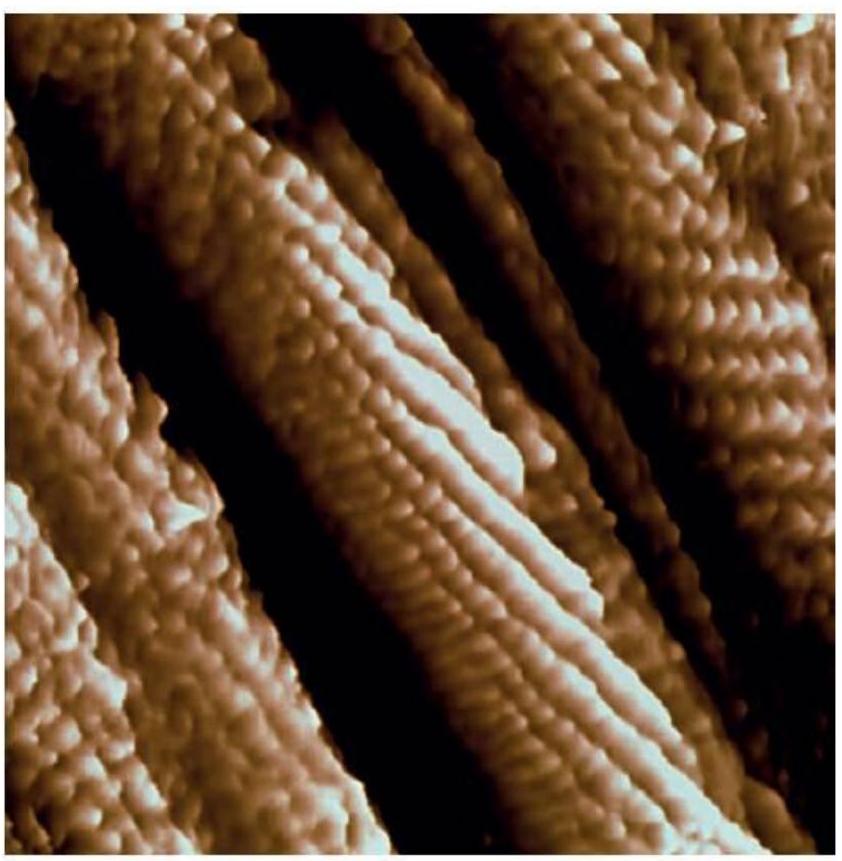
Figure 1.4 Coloured scanning tunnelling electron micrograph of carbon nanotubes, comprised of rolled sheets of carbon atoms. Individual atoms are seen as raised bumps on the surface of the tubes.
Standard Form
Standard form
The numbers that chemists deal with can often be very large, or very small. To make these more manageable, and to avoid having to write long lines of zeros (with the accompanying danger of miscounting them), we often express numbers in standard form.
A number in standard form consists of two parts:
- The first is a number between 1 and 10
- The second is the number 10 raised to a positive or negative power
Some examples, with their fully written-out equivalents, are given in Table 1.1.
Table 1.1 Standard form
| Standard form | Fully written-out equivalent |
|---|---|
| $ 6 \times 10^2 $ | 600 |
| $ 7.142 \times 10^7 $ | 71420000 |
| $ 2 \times 10^{-6} $ | 0.000002 |
| $ 3.8521 \times 10^{-4} $ | 0.00038521 |
If the 10 is raised to a positive power, the superscript tells us how many digits to the right the decimal point moves. As in the examples in Table 1.1, we often need to write extra zeros to allow this to take place.
If the 10 is raised to a negative power, the superscript number tells us how many digits to the left the decimal point moves. Here again, we often need to write extra zeros, but this time to the left of the original number.
Sign up to track progress
Create a free account to mark lessons complete, track your learning progress, and access study tools